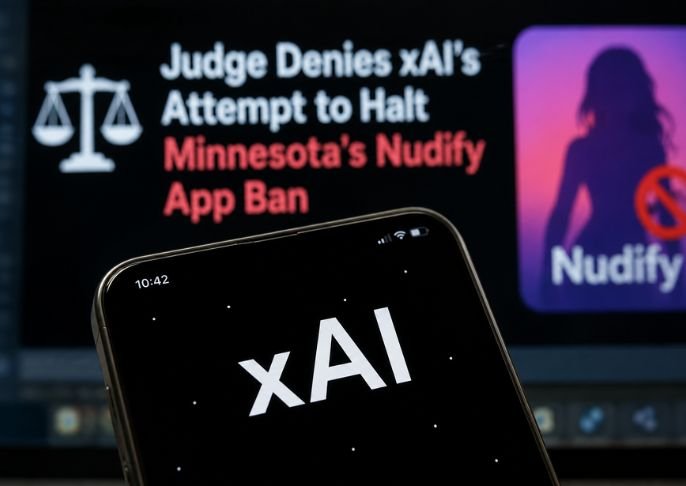
Minnesota’s ban of AI “nudification” apps became Minnesota’s first law to pass a major legal test and the first law of its kind in the nation. xAI, one of the investors of Elon Musk’s AI company, presented the first major legal challenge to the law. As always, pushwiki has you covered with a detailed analysis of the challenge, the reasoning behind the ruling, and the potential outcomes moving forward.
What Happened
On July 31, 2026, U.S. District Judge Donovan Frank denied xAI’s request for a temporary restraining order that would have Minnesota’s Nudify Ban Law (the first in the nation) stop from going into effect. The law would make illegal apps and websites that aid users in digitally “nudifying” (transforming a real, identifiable image of a person by adding or generating some intimate body parts that were not in the original image) images. The law, with xAI’s request denied, went into effect on its scheduled date of August 1, 2026.
Why the Judge Ruled Against xAI
The lack of urgency of xAI’s challenge to the law also justified Judge Frank’s ruling. xAI filed its motion for emergency relief on July 29, 2026, three days before the law would go into effect, and almost three months after the law’s signing by Minnesota Governor Tim Walz (in May). The Judge attributed xAI’s delayed filing to a lack of an actual threat of immediate and irreparable harm, which usually is justified by the filing of the motion to the court.
This ruling does not dismiss xAI’s other prosecution. The judge interprets the instance as a request for a preliminary injunction, and a substantive hearing will take place on August 19, 2026, for the additional substantive and constitutional matters.
What is Minnesota’s Law?
Under HF 1606, the Law is specifically aimed at the operators of nudification technology (not targeting the individual users of the technology). The Law states that a “nudified” image refers to an image that has been edited or created in a way that depicts a computer generated or modified intimate body part of a person that, in the original image or video, is not present, in a way that is so realistic that a viewer, in good faith, would believe that the image or video is real.
The Law has massive financial implications: violators may be subject to civil penalties of a half a million dollars for each violation. The Law passed in Minnesota with massive bipartisan support (132 to 1 in the House and 65 to 0 in the Senate).
What are xAI’s Claims?
xAI, the developer of Grok chatbot and related AI Image Generation tools, does not contest the goal of Minnesota’s Law. In its lawsuit, the company states that it does not contest the State of Minnesota’s desire to stop the distribution of AI generated images of nudity of real persons createdС without their express consent.
The objection relates to the scope of the law. According to xAI, the law is written too broadly because it is an overbroad, content-based restriction on free expression. xAI claims the law is not limited to the regulation of tools that produce nonconsensual intimate imagery, and includes lawful image editing tools and protected speech. xAI claims that in such cases, less speech restrictive, more narrowly tailored options would be available to achieve the protective intent behind the law.
Why this case is getting national attention
This case is getting attention well beyond Minnesota for a number of reasons:
First, this is a legal first- No state has passed a nudification-specific ban and as such this case, potentially, is the first example in the world of how far state-by-state regulation will go for AI-generated content.
Second, Grok image tools are already in the crosshairs elsewhere– The xAI “Imagine” feature is already facing criticism from the public, and the company is being sued in the UK by a member of Parliament because of sexualized Grok images.
Third, there is a focus on regulation as a whole- Reports are circulating that California, the EU, and Ireland have begun their own investigations relating to Grok image generation.
And finally, there is a focus on the Federal vs- State issue. This case concerns the wider debate of whether each individual state should be free to regulate AI as they see fit, or if AI should be regulated at the National level.
What Happens Next
Currently, Minnesota’s ban is in place, and xAI’s main argument — that the tools of image generation are First Amendment protected, because images can be generated in any form, including images of a non-consensual nature — has yet to be evaluated on its substance. This will be the primary focus of the August 19 preliminary injunction, where a federal court will address whether the law can remain as is or if it must be altered to be more specific.
Final Thoughts
This decision does not resolve the larger issue. It simply allows the Minnesota law to be in effect while the actual litigation occurs in the following weeks. With an August 19 hearing and similar emerging concerns with AI imaging in other countries, this case will most likely influence other states’ laws on the regulation of AI.
Also Read: ChatGPT Plus Costs Less Through GamsGo. Here’s What You Actually Get