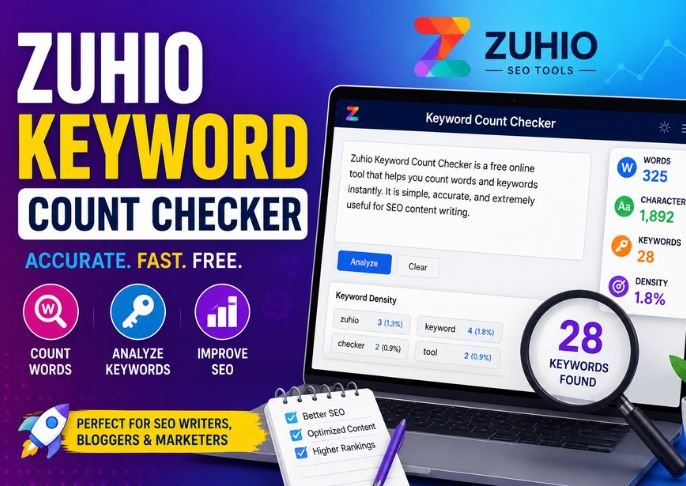
If you’ve ever finished writing a blog post and wondered whether you’ve mentioned your target keyword enough — or way too much — you’ve run into the exact problem the Zuhio Keyword Count Checker was built to solve. At Pushwiki, we broke down what this tool actually does, how to use it, and where it fits (and doesn’t fit) into your broader SEO workflow.
What Is the Zuhio Keyword Count Checker?
The Zuhio Keyword Count Checker is a free, web-based tool hosted at zuhio.com that scans a block of text and reports two simple numbers: how many times your chosen keyword appears, and what percentage of your total word count that represents — commonly known as keyword density.
It’s a single-purpose tool by design. You paste in your content, enter the keyword you want to track, and it returns the count and density instantly. No account creation, no learning curve, and no complicated dashboard to figure out first.
Why Keyword Density Still Matters (A Little)
Keyword density had its heyday years ago, when stuffing a page with a target phrase was a common (and now outdated) ranking tactic. Search engines have gotten far smarter about understanding context since then, and pure keyword density is nowhere near the ranking factor it once was.
That said, it hasn’t disappeared entirely — search engines still use keyword frequency as one of many signals to understand what a page is actually about. The real value of a tool like this isn’t chasing a “perfect” density percentage; it’s catching the two failure modes that still hurt content today:
- Using a keyword too little, which can make it harder for search engines to clearly identify your page’s topic
- Using a keyword too often, which reads as repetitive to human readers and risks looking like keyword stuffing to search engines
How to Use the Zuhio Keyword Count Checker: Step by Step
- Go to zuhio.com and open the Keyword Count Checker tool
- Paste your full article or content into the text field
- Enter the specific keyword or phrase you want to analyze
- Review the results: total keyword occurrences and density percentage
That’s the entire process — no setup, no sign-up wall, and results appear within seconds.
What the Tool Does — and Doesn’t — Do
It’s worth being upfront about the tool’s scope, since it’s intentionally narrow:
It does:
- Count exact keyword occurrences in your text
- Calculate keyword density as a percentage of total word count
It doesn’t:
- Analyze backlinks
- Perform technical SEO audits
- Suggest content topics
- Pull keyword search volume data
If that sounds limited, that’s the point. It’s a lightweight, single-metric checker meant to be paired with broader keyword research and technical SEO practices — not a replacement for a full SEO platform.
Who Should Use This Tool?
The Zuhio Keyword Count Checker is genuinely useful for:
- Bloggers writing long-form content who want to confirm keyword placement before publishing
- SEO specialists doing a quick content review without opening a full enterprise SEO suite
- Copywriters checking that a focus keyword hasn’t been accidentally overused on a short landing page
- Website owners managing their own content without access to paid SEO tools
- Content editors doing a final-pass review before a piece goes live
Best Practice: Use It at the Editing Stage, Not the Writing Stage
One tip worth keeping in mind: this type of tool tends to work best after you’ve written your content, not while you’re writing it. Trying to hit a specific keyword density while drafting usually produces stiff, unnatural-sounding writing. Writing naturally first, then checking your keyword count and density afterward as a final review step, generally leads to better content overall — and a healthier balance between readability and optimization.
Final Thoughts
The Zuhio Keyword Count Checker earns its place by doing one thing well — showing you, in seconds, whether your keyword usage is balanced. It’s not going to replace your keyword research process or a full SEO toolkit, and it isn’t trying to. Used at the right stage (editing, not drafting), it’s a quick, no-friction way to catch both underuse and overuse before you hit publish.
Also Read: How To Share Location Indefinitely From iPhone to Android